About Unequal
Collected link — not evaluated. Play unverified. No child-suitability or successful gameplay claim.
Official game board opened in AM02 ChatGPT in-app browser. Play inputs, completion, mobile and touch not tested. Opens on the official site.
- Game languages
- EN — English official UI/manual observed in 2026-11-02 research; no other language inventory verified
- Last recorded check
- 2026-11-03
- Desktop
- screen_opened
- Mobile
- Not checked
- User ad reports
- No public ad-report summary. Ads may exist.
- Age rating
- Not verified
- AI use (optional creator information)
- Not documented. AI use is not required for listing.
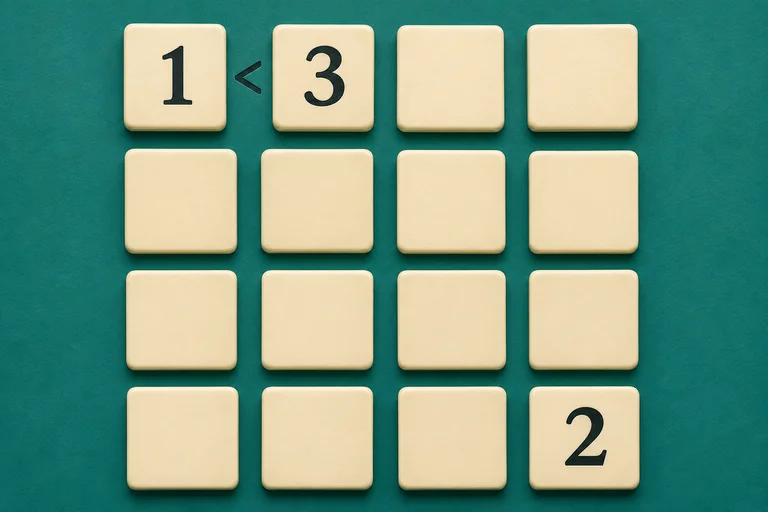
Unequal starts with a square grid and the familiar Latin-square constraint: every digit must appear exactly once in each row and column. In the main mode, greater-than and less-than markers between cells tell you how neighboring values compare. You use the visible relations to rule out impossible placements while keeping track of the digits that remain. The alternative Adjacent mode replaces inequality arrows with bars indicating neighboring numbers that differ by exactly one. The absence of a bar means those neighbors must not be consecutive. As you solve a board, you can enter permanent answers, keep pencil marks and mark completed clues. The official instructions document keyboard tools for auto-filling candidate notes and cleaning up obvious candidates.
Objective
Place one of each digit in every row and column and satisfy all visible inequality or adjacency conditions.
Progression
Choose Unequal or Adjacent mode, select board size and difficulty, and solve independently generated grids. Specific level counts or online progress were not verified.
Guide based on official sources; this is not a new gameplay or mobile compatibility test.
How to play
Left-click a cell, then type a digit to fill it. Right-click a cell, then type a digit for a pencil mark. Click a comparison clue to mark it as completed or unmark it.
Game details and verification record
Code license
Simon Tatham and contributors; exact per-file rights holders may differ
Applies to software code. Original game image, audio and iframe permissions remain unconfirmed. HopJelly uses an independent illustration and links to the original game.
Creator & sources
Created by James Harvey; Simon Tatham Portable Puzzle Collection.
Independent OpenAI ImageGen editorial concept illustration; not actual gameplay. No publisher screenshot, logo or game asset copied.
External game content remains with its creator. An accessible URL does not grant permission to embed it. Mobile controls and language support may be unverified.
 Six Cats UnderIllustration — not gameplay
 Taiyaki Fabulous Museum of FishIllustration — not gameplay
 Choo Choo ManiaIllustration — not gameplay
 SPLOOBIllustration — not gameplay
 b-e-e-t-l-eIllustration — not gameplay
 DragonsweeperIllustration — not gameplay
 Moss MossIllustration — not gameplay
 PrerolledIllustration — not gameplay
 The Roottrees are DeadIllustration — not gameplay
 Little Chef: DemoIllustration — not gameplay
 The Legend of LuminaIllustration — not gameplay
 Lockpicks-11Illustration — not gameplay
 HER TREES : First PuzzleIllustration — not gameplay
 Combo PoolIllustration — not gameplay
 ROTETRAIllustration — not gameplay
 0h h1Illustration — not gameplay